
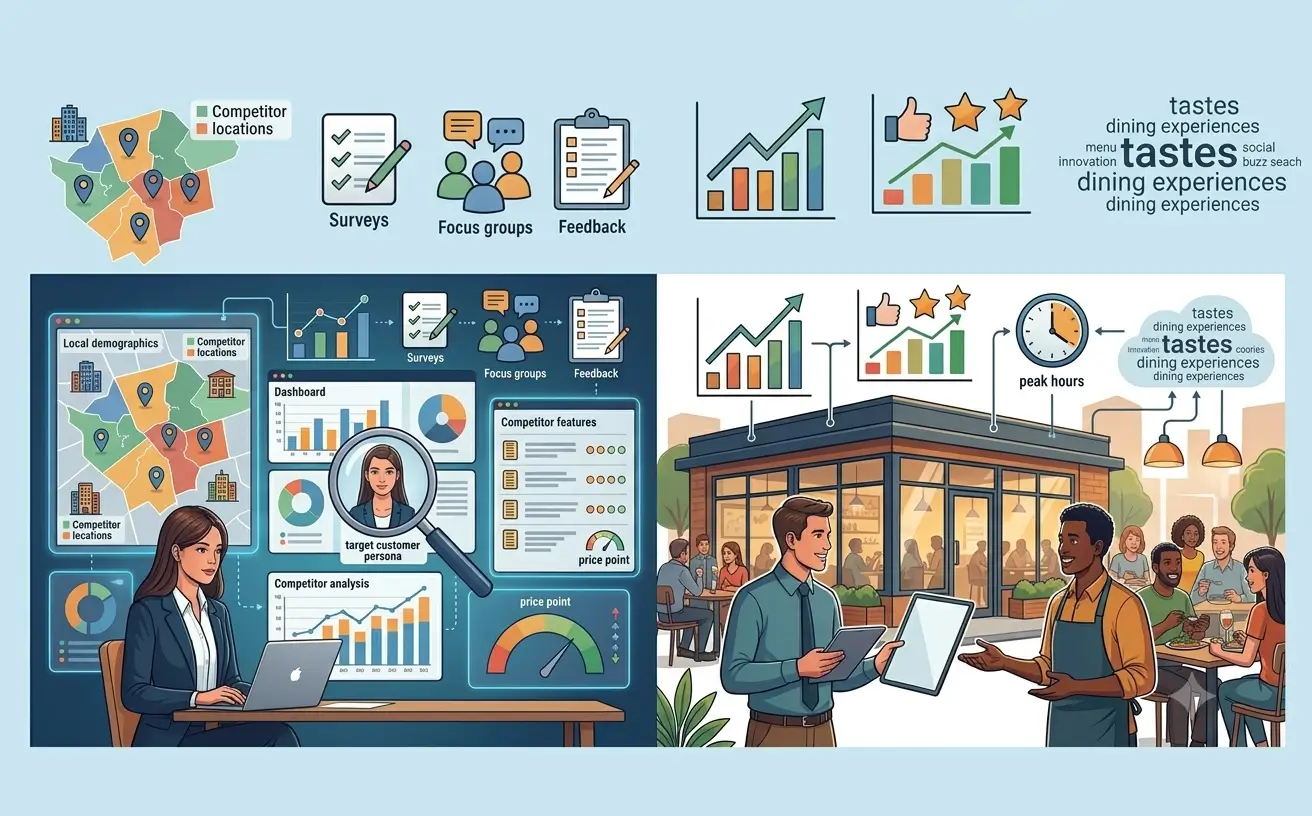
If you are planning to open a restaurant, knowing how to do market research for a restaurant is not just useful advice, it is quite possibly the single most important thing standing between you and becoming another closure statistic.
India’s restaurant industry is valued at $85.19 billion in 2025 and growing at a CAGR of 10.41%, yet around 60 to 73% of new restaurants in the country shut down within their first year.
The most frequently cited reasons are poor location choices, misjudged pricing, and a fundamental mismatch between what the restaurant offers and what the local market actually wants.
That last point is the one that market research solves directly. Done well, it tells you who your customers are, what they want to eat, how much they are willing to pay, who else is serving them, and what gap your restaurant can credibly fill.
Done poorly or skipped entirely, it leaves those questions unanswered until the market gives you a very expensive answer of its own.
Here is a practical, step-by-step guide to doing restaurant market research properly, even if you are starting from scratch with no prior experience in the food business.
Step 1: Define Your Concept Before You Research It
Market research does not begin with data collection. It begins with a clear enough concept to know what you are actually researching.
Are you opening a quick-service lunch spot for office workers? A full-service family dining restaurant? A cloud kitchen focused on delivery? A specialty café?
Each of these has a completely different target customer, a different competitive landscape, and different location requirements. Without clarity on your concept, you end up collecting general information that does not actually tell you whether your specific idea will work in your specific area.
So before doing anything else, write down in two or three sentences what your restaurant will offer, who it will serve, and what will make it different from everything already available nearby.
You can also read: How to Generate Leads from Instagram for Local Businesses
Step 2: Understand the Market You Are Entering
Once your concept is defined, the next step is understanding the broader market context.
India’s food service sector contributes 1.9% to GDP, and urban Indians currently dine out around five times a month on average, a number expected to rise to seven or eight times monthly in the coming years.
Online food delivery alone is projected to reach $54.97 billion in 2025, with 70% of restaurant revenue in Tier 1 cities now coming from digital orders.
Understanding these macro numbers matters because they shape the environment your restaurant will operate in.
A delivery-first model enters a segment growing at 13.67% CAGR, meaning both growing opportunity and growing competition.
A full-service restaurant in a Tier 2 city enters a segment that is just beginning to formalize, which could mean lower immediate competition but also a less developed dining culture to work with.
Read the India Food Services Report published by the National Restaurants Association of India, check sector reports from NRAI and Mordor Intelligence, and look at what cuisine categories are growing fastest in your target region. This background research prevents you from building a concept in a declining segment or missing an emerging one entirely.
You can also read: How to Use Social Media for Local SEO: Rank Your Business in Patna
Step 3: Research Your Target Customer in Depth
General market data tells you about the industry. Customer research tells you about the people who will actually walk through your door, or place an order on your behalf. These are two different things, and both matter.
Start by defining your target customer as specifically as possible. Age range, income level, dining occasion (work lunch, family dinner, weekend brunch, late-night delivery), dietary preferences, and how they typically discover new restaurants are all relevant. Then go and find them.
Conduct surveys in your target location, whether through a Google Form shared in local WhatsApp groups, a short questionnaire at a nearby market, or in-person conversations with people who match your target profile.
Ask what cuisines they currently eat most often, what they feel is missing from the local dining scene, what price range they consider fair, and what matters most in a restaurant experience: food quality, speed, ambiance, delivery reliability, or value.
This qualitative data is often more revealing than any industry report because it captures the specific preferences and frustrations of your actual potential customers rather than national averages.
You can also read: 10 Reasons Your Brand Needs Video Marketing Strategy
Step 4: Analyse Your Competition Honestly
One of the most important and most commonly rushed steps in restaurant market research is competitive analysis.
It is not enough to know that competitors exist. You need to understand them well enough to know what they are doing well, where they are falling short, and what space that leaves for you.
Visit your top five to ten competitors in person if possible. Eat there. Note the pricing, the portion sizes, the service speed, the ambiance, the busiest times of day, and what customers seem to be ordering most.
Read their reviews on Zomato, Swiggy, and Google carefully. Negative reviews in particular are a goldmine: they tell you exactly what local customers are not getting from existing options, which is precisely where your opportunity might lie.
Look for patterns. If every competitor in your area has weak delivery reviews, a delivery-optimized kitchen could capture that frustrated audience. If the dominant price point in your locality is mid-range and nothing serves the premium segment, that gap may represent an underserved market.
Equally, if a particular cuisine category is heavily saturated with strong players, entering that exact space without a meaningful differentiator is a risk worth taking seriously.
You can also read: Paid Ads vs. Organic Social Media Growth: Which Is Better for Your Business?
Step 5: Choose Your Location Using Data, Not Intuition
Location is one of the top reasons Indian restaurants fail, which means it deserves far more rigorous analysis than a gut feeling about a neighbourhood you like.
The right location for your restaurant depends on foot traffic, proximity to your target customer base, visibility, accessibility, parking or delivery logistics, and the lease cost relative to projected revenue.
Walk the locations you are considering at different times of day and on different days of the week. Count foot traffic. Observe who is passing, whether they match your target customer profile, and what existing businesses are thriving nearby.
A location that works brilliantly for an office-focused lunch spot may be completely wrong for a family dinner restaurant that needs evening and weekend traffic.
Also check delivery radius practicality if your model includes online orders. A location that seems cost-effective may add 15 minutes to every delivery, directly affecting your ratings on aggregator platforms and your repeat order rate.
Step 6: Test Your Menu-Market Fit Before You Build
One of the most common and most expensive mistakes restaurants make is building out a full menu based on the owner’s preferences rather than the market’s appetite.
The concept of menu-market fit, matching what you serve to what your specific local customer base genuinely wants, is cited by restaurant industry researchers as one of the leading predictors of long-term success.
Before finalizing your menu, test it. Run a pop-up event, a home delivery pilot, or a catering arrangement that lets real potential customers try your food and give honest feedback.
Track which dishes generate the most excitement, which price points feel comfortable, and which items people put down after one bite. This data is worth far more than any internal tasting session.
You can also read: 7 Social Media Marketing Trends Every Business Adapt in 2026
How TrendShout Helps Restaurants Translate Market Research Into Growth
Doing solid market research tells you where your opportunity is. Turning that opportunity into actual customers requires a digital presence, strong local visibility, and content that makes your restaurant impossible to ignore.
This is where TrendShout, a digital marketing agency in Patna, helps restaurants and food businesses bridge the gap between research and revenue.
TrendShout’s team builds restaurant marketing strategies grounded in exactly the kind of local consumer insight that market research uncovers.
Whether it is social media content that speaks directly to your target dining audience, paid campaigns designed to drive footfall and online orders, high-performing Reels that showcase your food in the format people actually watch, or local SEO that ensures you appear when hungry customers search for your cuisine type nearby, TrendShout’s end-to-end approach is built for local businesses that want measurable results rather than vanity metrics.
With a track record of generating over 100 million views for clients through expertly produced content, the TrendShout team understands that a restaurant’s digital presence is not separate from its market positioning.
It is an extension of it. The clearer your market research, the sharper and more effective your marketing becomes, and TrendShout is built to make that connection work for you.
Conclusion
Market research is not a one-time task you complete before opening and then forget. The most successful restaurants treat it as an ongoing habit, regularly checking reviews, monitoring competitor moves, tracking which menu items are performing, and staying close to how customer preferences are shifting.
The Indian food service market is growing fast and changing constantly, and staying informed is what keeps a restaurant relevant rather than reactive.
Start with a clear concept, understand your market, know your customer, study your competition honestly, choose your location with data, and test before you commit. Do those things well, and the odds shift meaningfully in your favour.
Ready to Turn Your Restaurant Concept Into a Local Success Story?
If you have done the market research and are ready to build a restaurant brand that actually reaches and converts your target customers, TrendShout is ready to help you make that happen.
Book a free strategy consultation with TrendShout today and let’s build a marketing plan as sharp as your concept.