
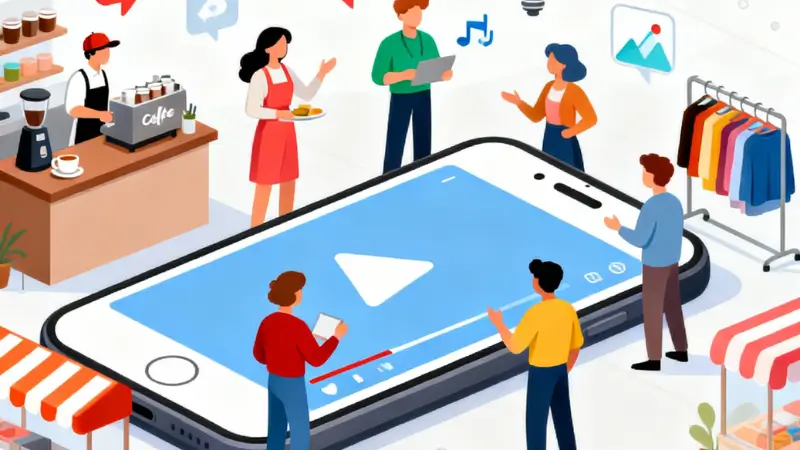
Video content is no longer just an add-on marketing tool for small businesses; instead, it has become one of the core ways customers discover, evaluate, and trust brands.
As attention spans shrink and algorithms favor short, engaging content, video now sits at the center of effective digital marketing.
In fact, various studies highlight just how influential video has become.
For example, Wyzowl’s Video Marketing Statistics report indicates that around 87% of viewers say a video has convinced them to buy a product or service.
Similarly, more than 90% of marketers state that video helps them generate leads.
Consequently, if your small business is still relying primarily on static posts or text-based content, you may be missing out on a massive opportunity.
So, this guide explores powerful, practical video content ideas for small businesses.
Let’s explore!
1. Foundational Brand Story Videos
Before chasing trends, transitions, and viral sounds, it is important to build a strong video marketing foundation.
Brand story videos create that foundation by telling people who you are, what you do, and why you exist.
Moreover, these videos help new viewers instantly understand your identity and feel a connection with your business.
a) “Who We Are” Brand Story
A “Who We Are” video acts as a visual elevator pitch for your business.
Rather than forcing visitors to read long paragraphs on your website, you allow them to see and hear your story in 60–120 seconds.
To make this effective, consider including:
- A brief origin story: When and how the business started.
- Your core offerings: What you actually sell or deliver.
- Your ideal customer: Who you are best suited to serve.
- Your unique angle: What makes you different from competitors.
- Visuals of your space or team: Offices, workshop, salon, studio, or store.
- A clear call to action: Visit, call, DM, book an appointment, or shop.
For example, imagine a local salon.
Instead of posting only haircut photos, the owner records a 90-second video where she speaks directly to the camera about why she started the salon, what type of clients she loves working with, and how the team focuses on comfort and hygiene.
Meanwhile, cutaway clips show the salon interiors, hair wash stations, styling moments, and relaxed, happy clients.
This helps potential customers see both the space and the personality behind it.
Once you create this video, you can use it in multiple places:
- As the main video on your website homepage.
- On your “About” page for deeper storytelling.
- As a pinned post on Instagram or Facebook.
- As your channel trailer on YouTube or Vimeo.
This way, every new visitor has a quick, engaging way to understand your brand.
b) “Why We Do What We Do” Mission Video
While a “Who We Are” video focuses on basic introductions, a mission video goes a level deeper.
It answers an emotional question: why does your business exist beyond making money?
This is particularly important because modern consumers increasingly want to support brands whose values align with their own.
They care about ethics, quality, sustainability, and authenticity.
Therefore, when you explain your “why,” you shift your business from a generic vendor to a brand with a purpose.
For example, a pet care brand might share that the founder’s own dog struggled with chronic skin allergies. After trying many harsh or ineffective products, the founder worked with vets to create gentle, science-backed formulas.
Sharing this story in a video, with real footage of the dog and the journey, immediately makes the brand more relatable and credible.
Practically, you can keep this mission video slightly more reflective and story-driven, while still keeping it concise.
Then, you can place it on your About page, share it as a social media post, or even use it in presentations and webinars to introduce your philosophy.
2. Product and Service Explainer Videos
Once people know who you are and why you exist, they naturally want to understand what you actually offer and how it works.
This is where product and service explainer videos become essential.
Explainer videos remove confusion, clarify value, and reduce perceived risk.
When prospects see your product or service in action, they are more likely to feel confident in taking the next step.
a) Simple Product Demos
For product-based businesses, straightforward demos are incredibly powerful.
Therefore, rather than relying only on static images, show your product being used in real situations.
Here are some angles you can use:
- Demonstrate how to use the product step by step.
- Highlight key features in a visual way instead of listing them as text.
- Show “before and after” results.
- Film the product in realistic environments, not just ideal studio settings.
Imagine a premium pet shampoo brand. A product demo might show:
- A dog before the bath, perhaps with a dull or dusty coat.
- A close-up of the product texture and lather.
- The shampoo being applied and rinsed, with emphasis on ease of use.
- A “after bath” results with a visibly shinier, softer coat.
Throughout the video, on-screen text or voiceover can highlight benefits like “pH balanced,” “vet-tested,” “paraben-free,” or “reduces itching.”
As a result, even a 45–60 second clip can communicate more value than multiple text posts.
To keep product demos effective:
- Make them short and focused (30–90 seconds).
- Avoid overloading viewers with too many features at once.
- Use simple language and visual clarity rather than heavy jargon.
b) “How Our Service Works” Walkthrough
Service-based businesses often face a different challenge: services are intangible.
As a result, many potential clients feel uncertain about what will happen after they enquire or pay.
Consequently, they hesitate.
To address this, a “How Our Service Works” walkthrough video can be a game-changer.
This video should break your process into clear, reassuring steps, such as:
- Initial inquiry or discovery call.
- Needs analysis and proposal.
- Service execution and communication.
- Delivery, review, and support.
For instance, a wedding photographer can walk through the entire journey: from filling out the contact form, to a consultation call, to pre-wedding shoots, to the actual wedding coverage, and finally to editing and delivery timelines.
Prospective couples then know exactly what to expect.
Importantly, these walkthroughs are highly reusable. You can:
- Embed them on your service pages
- Attach them to onboarding emails for new leads
- Share them in DMs when someone asks, “How do you work?”
By doing this, you not only save time but also ensure a consistent, polished first impression.
You can also read: Why Consistency Is More Important Than Virality in Social Media Marketing?
3. Customer Testimonial and Case Study Videos
Although your own claims matter, third-party proof matters more.
Testimonials and case studies show prospects that real people, like them, have already trusted and benefited from your business.
a) Simple Talking-Head Testimonials
The simplest form of video proof is a talking-head testimonial.
In this format, a satisfied customer speaks directly to the camera and shares their experience.
To make it structured and impactful, you can gently guide them to answer:
- What problem were they facing before working with you or using your product?
- Why did they choose you over alternatives?
- What results or improvements did they see?
- Would they recommend you, and if so, why?
For example, a dentist might feature a patient who explains how they were anxious about dental visits but felt comfortable at the clinic, appreciated the clear explanations, and are now confident in continuing regular check-ups.
To ensure high-quality yet still authentic testimonials:
- Record in a quiet environment with natural or soft lighting.
- Use a simple background; avoid distractions.
- Add captions, subtle branding, and a short intro/outro.
Even if the video is shot on a client’s phone, a little editing and formatting can make it look polished enough for your website and socials.
b) Mini Case Study Stories
While testimonials are quick and emotional, case studies are slightly more analytical and narrative-driven.
They walk viewers through a complete journey and show tangible results.
A simple structure for a mini video case study is:
- Client background and initial challenge.
- Your approach or solution.
- Quantifiable and qualitative results.
- Client’s reaction or feedback.
For example, a social media marketing agency might create a video titled: “How We Helped a Local Restaurant Increase Online Orders by 200% in 90 Days.”
It could show brief graphs or screenshots of order growth, ad campaigns, and social content.
By strategically using testimonial and case study videos, you turn your satisfied clients into powerful, ongoing marketing assets.
You can also read: 34 Social Media Marketing Strategies for Restaurants.
4. Educational and How-To Videos Content (Authority Builders)
Beyond proving that your business works, you also need to show that you actually know what you are talking about.
Educational and how-to videos help you demonstrate expertise while genuinely helping your audience.
Over time, this type of content builds long-term trust and organic discovery, especially through search platforms like YouTube and Google.
a) Tutorials and Step-by-Step Guides
Tutorials allow you to solve specific problems your audience faces.
The key is to choose topics that are genuinely useful and closely related to your products or services.
For example, an interior designer can create a video on, “How to Choose the Right Sofa Size for Your Living Room.”
The designer can explain measurements, clearance, scale, and color selection with on-screen illustrations.
For smooth flow:
- Start by stating the problem: “Most new home owners struggle with…”
- Then outline the exact steps, ideally with close-up shots and annotated text.
- Finally, end by summarizing the key takeaway and softly mentioning your product or service as a solution.
By doing this consistently, you position your brand as a practical, trustworthy educator.
b) “Explainer in 60 Seconds” Short Videos
Although detailed tutorials are valuable, not everyone has the time or attention to watch long videos.
Consequently, short, snackable education pieces work extremely well on Reels, Shorts, and TikTok.
Here are some simple formats:
- “3 mistakes to avoid when…”
- “Try this instead of that…”
- “If you’re a [target audience], here is one quick tip…”
For instance, a small café might share: “3 Mistakes to Avoid When Storing Coffee Beans at Home,” each point shown visually.
These videos build top-of-mind awareness.
Even if people are not ready to buy from you immediately, they slowly begin to see you as “the expert” in your niche.
You can also read: Short-Form vs Long-Form Videos: What Should Your Brand Focus On?
5. Behind-the-Scenes (BTS) and “Day in the Life” Videos
People are naturally curious. Therefore, they enjoy seeing what happens behind the curtain.
Behind-the-scenes (BTS) content satisfies this curiosity and makes your brand feel more human and transparent.
a) Process and Production BTS
BTS process videos showcase how your products or services come to life.
They highlight your effort, craftsmanship, and quality standards.
For example, a handmade jewelry brand can showcase sketching, stone selection, metalwork, and final polishing.
This process illustrates why the accessories cost more than mass-produced alternatives.
When you share such content, you reinforce the idea that your business is careful, diligent, and committed to quality, even if the customer never sees these steps in person.
b) “Day in the Life of a [Your Role]”
In addition to process videos, “day in the life” content allows your audience to connect with you personally.
By documenting a typical workday, you illustrate your routine, workload, and values.
For example, “Day in the Life of a Small Business Owner Running a Boutique Agency” might show morning planning, client calls, content reviews, and late-night strategy work.
Moreover, these videos work especially well on Instagram Reels, TikTok, and YouTube Shorts because they feel authentic and relatable.
At the same time, they subtly communicate how hard you work for your customers.
6. FAQ and Objection-Handling Videos
Almost every small business receives repeated questions: about pricing, timelines, safety, suitability, policies, and more.
Instead of answering each person individually, you can turn these recurring questions into valuable video content.
a) FAQ Series
Creating a dedicated FAQ video series allows you to address common doubts one by one.
Each video can focus on a single question, making it easy to search, save, and share.
For instance:
- “Can Puppies Use This Shampoo?”
- “Do I Need to Be Present During the Home Interior Work?”
- “How Long Does a Dental Cleaning Appointment Take?”
- “What Happens if I Don’t Like the First Logo Draft?”
These videos serve three major functions:
- They save your time in customer support.
- They reduce friction in the buying process by clarifying expectations.
- They signal transparency, which increases trust.
You can then organize these videos into a playlist on YouTube, highlight them under Instagram story highlights, or embed them into your FAQ page.
b) Objection-Handling Videos
Beyond factual questions, people also have unspoken objections or hesitations.
They may worry about cost, effectiveness, risk, or inconvenience.
Consequently, if you proactively address these concerns via video, you make it easier for them to say “yes.”
Some examples of objection-focused video topics include:
- “Is Professional Grooming Really Necessary if I Bathe My Dog at Home?”
- “Why Our Service Costs More Than Some Alternatives (And What You Get in Return).”
- “What If This Program Doesn’t Work for Me?”
These videos:
- Show that you understand your audience’s concerns.
- Give you a chance to explain your value calmly and clearly.
- Can be shared during sales calls or sent as follow-up content.
By systematically creating FAQ and objection-handling videos, you build a library that supports your marketing and sales efforts at every stage of the funnel.
7. User-Generated Content (UGC) and Customer Participation
Not all powerful videos need to be produced by you.
In fact, user-generated content (UGC) can be more persuasive precisely because it comes from real customers.
a) “Show Us How You Use It” Campaigns
To encourage UGC, you can invite customers to share videos using your product or showcasing the result of your service. In return, you can offer small but meaningful incentives, such as:
- A discount on their next purchase.
- A chance to be featured on your page.
- Entry into a giveaway or contest.
For example, a restaurant could invite guests to record their first bite reactions to a new special dish.
Once the content starts coming in, you can:
- Repost it (with permission) on your social media accounts.
- Compile it into highlight reels.
- Use it in ads or landing pages as authentic social proof.
This not only provides you with more content at lower cost but also deepens your relationship with customers, as they feel valued and seen.
b) Reaction and Stitch Videos
If you are active on platforms like TikTok, Instagram Reels, or YouTube Shorts, you can take UGC further by interacting with it publicly.
For instance, you can:
- React to customer videos using your products, adding your commentary or gratitude.
- Stitch or remix their videos with your own clips, providing extra tips or clarifications.
By doing so, you create a dynamic loop between your brand and your community.
Moreover, viewers see that your brand is not distant, but responsive and engaged.
You can also read: 18 Free YouTube Marketing Tools to Grow Your Channel.
8. Local-Focused and Community Videos
For many small businesses, local visibility matters more than global reach.
Video can play a powerful role in positioning you as a local expert and community partner.
a) Neighborhood Guides and Local Tips
Instead of talking only about your business, you can create videos that highlight your city, neighborhood, or surrounding ecosystem.
While these videos still feature your brand, they feel more like helpful guides than direct promotions.
For example, a fitness studio could post: “Healthy Breakfast Spots Near [Studio Name],” recommending local partners.
Such videos:
- Attract local search and geotag-based discovery.
- Build goodwill with neighboring businesses.
- Make your brand feel integrated into the community rather than isolated.
b) Collaboration Videos with Other Local Businesses
To deepen community ties, you can also collaborate with complementary local businesses.
This not only expands your reach but also creates richer content.
Possible collaborations include:
- Salon + spa
- Café + bookstore
- Vet clinic + pet supply store
- Interior designer + furniture store
Here are some video content ideas:
- Joint live sessions discussing combined topics, such as “Home Styling and Coffee Rituals” or “Pet Health + Grooming Q&A.”
- Co-created Reels showcasing both locations, perhaps in a “day out” or “makeover” format.
- Short interviews where each business owner introduces the other and shares why they recommend them.
Through such collaborations, you access new audiences while reinforcing your position as a trusted local player.
You can also read: 10 Top Benefits of Influencer Marketing.
9. Live Videos: Q&A, Launches, and Workshops
While pre-recorded videos offer more control, live videos provide immediacy and interaction.
When done well, they can significantly deepen your connection with your audience.
a) Live Q&A Sessions
Live Q&A sessions invite your audience to ask questions in real time.
This format is particularly effective when you focus on a specific theme or problem.
Possible video content topics:
- “Ask Me Anything About Starting a Side Business While Working Full-Time.”
- “Live Q&A: Pet Grooming, Skin Issues, and Bath Routines.”
- “Ask an Interior Designer: How to Maximize Small Spaces.”
To make live sessions productive:
- Announce them 2–3 days in advance and remind your audience on the day.
- Collect questions via Instagram Stories, DMs, or email beforehand.
- Prepare short, clear answers and examples to keep the pace engaging.
- Save the live replay and repurpose the best segments into shorter clips for later posts.
As a result, one live session can generate multiple pieces of content while simultaneously strengthening trust.
b) Live Product Launch or New Service Announcement
Instead of quietly releasing a new product or service with one static post, you can turn the launch into a live event.
A live launch might include:
- The story behind the product or service.
- A real-time unboxing or demo.
- Frequently asked questions about usage, pricing, and availability.
- A special offer for live viewers (for example, a discount code valid for a few hours).
Because live events feel time-sensitive and interactive, they create excitement and urgency, even if you are addressing a relatively small audience at first.
10. Short-Form Content for Reels, Shorts, and TikTok
At this point, it is clear that short-form vertical video dominates much of today’s social media landscape.
Platforms like Instagram, YouTube, and TikTok aggressively promote Reels and Shorts, making them ideal for small businesses seeking organic reach.
a) “Hook + Value” Quick Tips
To succeed in short-form, you need strong hooks and fast delivery.
Viewers decide within the first 2–3 seconds whether to keep watching or swipe away, so your opening line and visuals must be compelling.
Hooks might start with:
- “Stop doing this with your dog’s coat…”
- “If you run a small business, you need to hear this…”
- “Most people waste money on this; here’s a better way…”
Then, in the next 10–20 seconds, deliver one clear, specific insight. After that, end with a simple call to action such as:
- “Follow for more tips like this.”
- “Save this video for later.”
- “DM us if you want help with this.”
This concise structure is not only algorithm-friendly but also respectful of your audience’s time.
b) Transformation and Before/After Videos
Another powerful short-form concept is transformation.
Humans naturally respond to visible change, whether it is a physical makeover, a room renovation, or a business improvement.
Examples include:
- Before/after living room or kitchen renovation by an interior designer.
- Before/after dog grooming sessions, haircuts, or spa treatments.
- Before/after brand identity redesigns, including logos, websites, and social media feeds.
- Before/after landscaping or construction projects.
By pairing these transformations with trending sounds, quick cuts, and short captions, you can create highly shareable content that attracts not only potential clients but also people who simply enjoy watching satisfying changes.
11. Seasonal, Event, and Trend-Based Videos
In addition to evergreen content, you can amplify relevance and engagement by aligning certain videos with seasons, holidays, and trends.
a) Seasonal and Event-Based Content
Every business experiences its own seasonal patterns.
For example, wedding photographers have peak seasons, financial advisors have year-end rushes, and retail sees spikes during festivals.
By planning a proper video marketing strategy around these periods, you can anticipate customer needs.
Some video content ideas:
- A pet care brand: “Festive Grooming Tips for Diwali So Your Dog Stays Safe and Comfortable.”
- A tax or financial advisor: “Year-End Financial Checklist for Small Businesses,” shared just before fiscal deadlines.
- A construction or home improvement business: “Monsoon Home Maintenance Tips for Apartment Owners,” published before the rainy season.
These videos help your audience solve time-sensitive problems, which makes your brand appear proactive and thoughtful.
b) Trend-Based and Audio-Based Content
On platforms like Instagram and TikTok, trending sounds and formats can give your content a short-term boost.
However, it is important to use trends strategically rather than copying them blindly.
You can:
- Take a popular audio clip and add an on-screen twist related to your niche.
- Participate in fun challenges only if they can be naturally connected to your business.
- Combine a trending format with your own educational or humorous overlay text.
By doing this, you ride the wave of the trend while still reinforcing your positioning instead of diluting it.
You can also read: Why Your Business Needs a Strong Online Presence?
12. “Meet the Team” and Culture Videos
Beyond products, processes, and tips, many viewers want to know the people behind a brand.
When they see real faces and personalities, they feel safer investing their money and attention.
a) Team Introductions
Short team introduction videos can be very effective. Each team member can share:
- Their name and role.
- One fun or humanizing fact about themselves.
- One small piece of advice or perspective related to their job.
For example:
- “Meet Dr. Riya, our vet advisor. Here’s her number one tip for dogs with sensitive skin.”
- “Meet Ankit, our project manager, who ensures your construction projects stay on schedule.”
These videos serve several purposes at once. They:
- Showcase your team’s expertise.
- Demonstrate that you are not a one-person, unstable operation (if that is the case).
- Make customers feel more comfortable interacting with your staff.
b) Culture and Fun Moments
While professionalism matters, occasional glimpses of your team’s personality can make your brand more likable.
Culture videos content ideas might include:
- Birthday celebrations or small office parties.
- Team outings and volunteer days.
- Bloopers and lighthearted behind-the-scenes moments during shoots.
The key is to balance fun with relevance.
You want to appear approachable and human, but not chaotic or unprofessional.
When done right, culture content can foster emotional connection without undermining your expertise.
13. Thought Leadership and Opinion Videos
For consultants, agencies, coaches, and expertise-based businesses, thought leadership can be a major differentiator.
Instead of simply describing what you do, you express clear, informed opinions about your industry.
Opinion videos might cover topics like:
- “Why Consistency Beats Virality for Small Business Marketing.”
- “Why Most Local Businesses Waste Money on Generic Ads.”
- “The Future of Pet Care: Science-Backed Formulas vs. Vague ‘Natural’ Claims.”
Structurally, you can:
- State a strong, clear thesis.
- Provide 2–3 supporting points, using examples or data.
- End with a concise takeaway or recommended action.
Over time, such content positions you as a strategic, big-picture thinker rather than only a doer.
Consequently, you may attract higher-quality clients who appreciate your perspective and are willing to pay more for your expertise.
14. Platform-Specific Optimization Tips (So Your Videos Actually Perform)
While ideas are critical, distribution and optimization determine whether your videos are actually seen.
Therefore, understanding platform nuances matters.
a) Instagram Reels and TikTok
On these platforms:
- Aim for shorter durations (often 7–30 seconds) for discovery-oriented content.
- Use vertical format, 9:16, to occupy the full screen.
- Add on-screen text or captions, since many users watch without sound.
- Write concise, engaging captions that provide context or a hook.
- Use 2–8 relevant hashtags that match your niche and audience, rather than long, generic lists.
- Post consistently, for example 3–5 times per week, instead of irregular, intense bursts.
By doing so, you signal to the algorithm that your content is engaging and worth recommending.
b) YouTube and YouTube Shorts
YouTube supports both long-form and short-form content, which allows you to build depth and breadth simultaneously.
For long-form:
- Create 8–15 minute videos that cover topics in detail (tutorials, explanations, case studies).
- Design clear, clickable thumbnails with contrasting colors and short, readable text.
- Include relevant keywords in your title and description in a natural, non-spammy way.
- Add timestamps for longer videos to improve user experience and retention.
For Shorts:
- Reuse or adapt your Reels and TikToks.
- Keep them under 60 seconds and use the vertical 9:16 format.
- Use hooks and strong visuals, just as you would for other short-form platforms.
By building a library on YouTube, you also increase your chances of appearing in Google search results over time.
You can also read: 19 Strategies to Market Your YouTube Channel.
c) Websites and Landing Pages
In addition to social media, your own website is a crucial place to embed video content.
When used correctly, videos can improve time-on-page, clarify your offer, and increase conversions.
On your site:
- Place explainer or brand story videos near key CTAs, such as “Book Now” or “Request a Quote.”
- Use testimonial or case study videos close to pricing sections to reinforce value.
- Add transcripts or summaries below each embedded video for accessibility and SEO.
- Host videos on platforms like YouTube or Vimeo and then embed them, so your site loads faster.
By integrating video into your website experience, you ensure that every visitor encounters richer, more persuasive content.
15. A Simple Content System: Turn One Video Content Idea into Multiple Ones
One of the biggest challenges small businesses face is consistency.
However, the solution is not to constantly chase new ideas; instead, it is to repurpose strategically.
For example, imagine you create a 10-minute YouTube tutorial: “How to Plan a Month of Social Media Content as a Small Business.”
From this single video content, you can:
- Cut 5–7 short clips (each 15–45 seconds) for Reels, Shorts, and TikTok.
- Extract main steps and turn them into a carousel post or infographic.
- Convert key quotes into LinkedIn or Twitter posts.
- Record a 60-second “summary” version for busy viewers.
- Embed the full video inside a related blog post to boost SEO and dwell time.
By following this system, one strong idea can fuel an entire week or more of content.
Consequently, you maintain consistency without burning out.
You can also read: Why Video Content Is the Future of Digital Marketing?
Conclusion: Start Small, Improve Continuously
Many small businesses delay video marketing because they feel overwhelmed.
They believe they must have the best video marketing tools, perfect equipment, flawless scripts, or cinematic editing before they start.
However, in practice, most audiences do not expect that level of polish, especially from authentic local or niche brands.
Instead:
- A clear message, decent lighting, and a smartphone are enough to start.
- Consistent posting beats sporadic perfection.
- Genuine value and sincerity usually matter more than advanced production techniques.
Therefore, focus first on:
- Explaining what you do and why in simple, honest videos.
- Showing real people, real processes, and real results.
- Educating your audience with concrete, actionable tips.
When you do this consistently, video naturally becomes one of your most powerful engines for awareness, trust, and sales.
And if you need a professional video marketing agency in Patna, you can contact us ASAP.