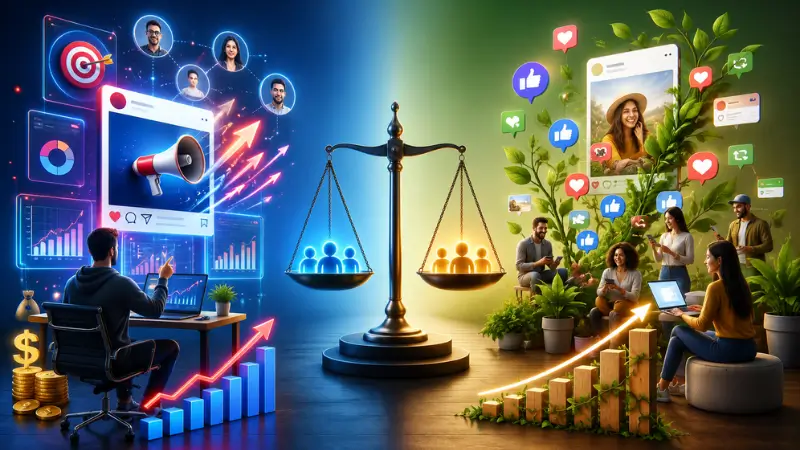
In the fast-paced world of social media marketing, business owners and marketing managers often find themselves at a crossroads.
On one hand, you have the allure of “viral” organic growth, the dream of building a massive, loyal following without spending a dime on placement.
On the other hand, there is the undeniable power of paid advertising, the ability to “flip a switch” and see traffic flow to your website instantly.
But here is the reality: the digital landscape has shifted. The days of effortless organic reach are largely behind us, yet the costs of paid acquisition are rising. This leads to the ultimate question: Which is better for your business?
In this guide, we will dive deep into the data, the pros and cons of each approach, and help you determine the right strategy for your specific business goals.
1. The Reality of Organic Social Media Growth: The “Long Game”
Organic social media growth refers to the reach and engagement you gain through free tools and natural interaction. This includes posting regular updates, sharing educational content, and engaging with your community in the comments.
The Benefits of Organic Growth
- Cost-Effectiveness: Technically, organic posting is free. While it requires time and talent (which have costs), you aren’t paying a platform to show your content to users.
- Trust and Authenticity: Consumers are increasingly skeptical of ads. According to various consumer sentiment reports, roughly 70% of users prefer getting to know a company via articles or organic posts rather than ads.
- Community Building: Organic social is where you build a “brand soul.” It allows for two-way conversations that foster long-term loyalty.
- Search Engine Synergy: Strong social signals can indirectly benefit your SEO. When people search for your brand and find active, helpful social profiles, it reinforces your authority.
You can also read: Why Consistency Is More Important Than Virality in Social Media Marketing?
The Drawbacks and The “Reach Crisis”
The biggest challenge today is “Organic Reach Decay.”
Over the last decade, platforms like Facebook and Instagram have significantly throttled organic reach to prioritize content from friends and family, and to encourage businesses to buy ads.
Industry benchmarks suggest that the average organic reach for a Facebook post is now hovering around 2.2% to 5.2%.
This means if you have 1,000 followers, only about 20 to 50 of them might actually see your post in their feed.
Moreover, organic growth is a slow burn. It can take months or even years of consistent posting to see a meaningful impact on your bottom line.
You can also read: Why Facebook Is Still a Powerful Platform for Small Businesses in 2026.
2. The Power of Paid Advertising: The “Fast Track”
Paid advertising (PPC, Social Ads, Sponsored Content) involves paying a platform to display your content to a specific target audience.
The Benefits of Paid Ads
- Instant Visibility: Unlike organic growth, which takes time to gain momentum, paid ads can put your brand in front of thousands of people within minutes of launching a campaign.
- Hyper-Targeting: The “secret sauce” of social media paid ads is targeting. You can reach people based on their job titles, recent life events (like moving or getting engaged), specific interests, or even their physical location.
- Scalability: If you spend $100 and make $300 in profit, you can theoretically scale that spend to $1,000 or $10,000. It is a predictable growth lever.
- A/B Testing: Paid platforms allow you to test different headlines, images, and offers simultaneously to see exactly what resonates with your audience.
The Drawbacks of Paid Ads
- The “Pay-to-Play” Trap: The moment you stop spending, your traffic stops. You aren’t building an asset that lives on; you are renting space in a feed.
- Rising Costs: As more businesses enter the auction, the Cost Per Mille (CPM) and Cost Per Click (CPC) continue to rise. Between 2021 and 2023, many industries saw a 15-25% increase in advertising costs on major platforms.
- Ad Fatigue: Modern users have developed “banner blindness.” If an ad feels too “salesy,” users will scroll right past it.
You can also read: How to Reduce Cost Per Lead with Smart Targeting?
3. Comparing the Two: A Side-By-Side Analysis
To help you visualize the differences, let’s look at how these two methods stack up against key business metrics.
| Feature | Organic Growth | Paid Advertising |
| Speed of Results | Slow (Months/Years) | Fast (Hours/Days) |
| Cost Structure | High Time / Low Direct Cash | Low Time / High Direct Cash |
| Sustainability | High (Built-in audience) | Low (Stops when payment stops) |
| Targeting | Broad / Follower-based | Laser-focused / Data-driven |
| Credibility | Very High (Earned trust) | Moderate (Paid placement) |
Which One Is Right for Your Business?
There is no one-size-fits-all answer, but we can categorize the choice based on your current business stage and objectives.
Use Organic Growth Primarily If:
- You are on a shoestring budget: If you have more time than money, organic content is your best friend.
- You are in a “High-Trust” industry: Professionals like therapists, coaches, or high-end consultants need to build deep rapport before a sale happens.
- You want to define your brand voice: Use organic to experiment with your message before putting money behind it.
Use Paid Ads Primarily If:
- You have a new product launch: You can’t wait six months for the algorithm to find your audience; you need sales now.
- You have a high Customer Lifetime Value (CLV): If one customer is worth $5,000 to you, spending $100 on an ad to acquire them is a no-brainer.
- You need to validate a business idea: If you want to know if people will buy your product, run a $500 test campaign. The data will tell you the truth faster than organic posting ever could.
You can also read: 9 Steps to Conduct a Social Media Audit for Your Business.
5. The “Golden Middle”: The Hybrid Strategy
The most successful businesses today don’t choose one or the other. Instead, they use a Hybrid Strategy where organic and paid work in a feedback loop.
How to Execute the Hybrid Model:
- The “Testing Ground”: Post 5-10 organic pieces of content per week. Monitor which ones get the most natural engagement.
- The “Amplifier”: Take your top-performing organic post (the one that clearly resonated with people) and turn it into a paid ad. Because it is already “market-tested,” it is much more likely to convert.
- Retargeting: This is the most efficient use of paid ads. Use organic content to bring people to your site, then use low-cost paid ads to “retarget” those visitors and remind them to finish their purchase.
Research shows that consumers need to see a brand 7 to 13 times before they are ready to buy.
Moreover, a hybrid strategy ensures you are hitting those touchpoints through both helpful organic content and strategic ad reminders.
You can also read: 10 Social Media Marketing Mistakes Businesses Make (And How to Fix Them).
6. Measuring Success: KPIs You Should Track
Don’t just post and pray. You need to measure what matters.
For Organic Growth:
- Engagement Rate: Are people commenting and sharing?
- Follower Growth Rate: Is your community actually expanding?
- Inbound DMs: Are people asking questions about your services?
For Paid Ads:
- ROAS (Return on Ad Spend): For every $1 you spend, how much do you make back?
- CPA (Cost Per Acquisition): How much does it cost to get one new customer?
- CTR (Click-Through Rate): Is your creative compelling enough to make people click?
You can also read: 5 Social Media Matrices You Must Track in 2026.
Conclusion
Ultimately, Organic Growth is your foundation, and Paid Ads are your fuel.
If you have a foundation of organic content, your paid ads will perform better because your profile looks credible.
Conversely, if you use paid ads, your organic following will grow faster as a side effect of increased brand awareness.
The Professional Advice: Start by dedicating 80% of your effort to creating high-value organic content that solves your audience’s problems. Once you have a message that resonates, dedicate a small budget (even $5-$10 a day) to amplify that message via paid ads.
By balancing the two, you create a social media marketing ecosystem that is both sustainable for the long term and aggressive enough to meet your short-term sales goals.
Ready to Scale Your Social Media Channel?
The choice isn’t between “Free” or “Paid;” it’s about how you value your time and how fast you want to grow.
Start building your organic community today, and use paid ads as the catalyst to take your business to the next level.
What is your biggest challenge with social media growth right now? Contact us today and let’s discuss!