
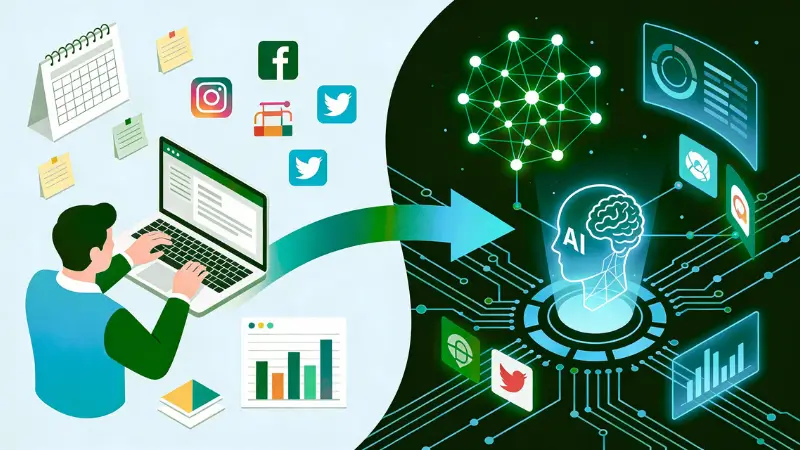
Artificial intelligence has evolved from a novel experiment to an essential driver of social media marketing strategies in 2026.
According to recent data, 97% of marketing leaders now believe that marketers must know how to use AI, while 43% consider it essential to their social media strategy.
This shift represents a fundamental transformation in how brands create content, engage audiences, and optimize their campaigns for maximum return on investment.
The social media marketing landscape is experiencing unprecedented disruption as AI technologies mature and become more accessible.
Furthermore, reports state that the AI in the social media market is projected to surge from $2.69 billion in 2025 to $9.25 billion by 2030, representing a compound annual growth rate of 28.04%.
As we navigate through 2026, understanding how AI is reshaping social media marketing has become critical for businesses that want to stay competitive and relevant in an increasingly automated digital ecosystem.
1. AI-Powered Content Creation at Scale
Content creation has undergone a revolutionary transformation with the mainstream adoption of AI-generated content in 2026.
Marketing teams no longer require advanced technical skills to bring social media posts to life; instead, they can focus on ideation and quality assurance while AI handles the foundational creative work.
This democratization of content creation has enabled businesses of all sizes to compete on a more level playing field.
The statistics supporting this transformation are remarkable.
A staggering 79% of creators report that AI enables them to produce more content faster, while 65% rely on AI for at least half of their posts.
Moreover, 90% of businesses using generative AI report significant reductions in production time, allowing marketing teams to allocate resources toward strategic planning rather than repetitive tasks.
This efficiency gain has translated directly into performance improvements, with 73% of businesses experiencing tangible engagement boosts from AI-assisted content.
The technology behind AI content creation continues to advance rapidly.
Text-to-video tools are projected to dominate 95% of platform inventory once fully automated workflows are in place, while new 3D AI tools like Meshy AI are on pace to overtake traditional content creation methods.
Consequently, specialized tools such as Jasper, Copy.ai, and ChatGPT have become staples for ad copy and campaign creation, while video marketing tools, like Runway and Synthesia dominate short-form production.
These platforms integrate seamlessly with existing marketing workflows, generating captions, suggesting hashtags, and drafting complete posts tailored to specific audience segments.
You can also read: Psychology of Viral Content: Why Some Posts Blow Up.
2. Predictive Analytics and Data-Driven Insights
Predictive analytics powered by AI has emerged as one of the most transformative trends shaping social media marketing in 2026.
These sophisticated social media marketing tools analyze patterns in social media data to forecast future behavior, helping brands improve timing and relevance in their content strategies.
Rather than relying on historical performance alone, marketers can now anticipate what their audiences want to see next, creating a proactive approach to content planning.
Moreover, the business impact of predictive analytics is substantial.
Companies using predictive analytics are 2.2 times more likely to exceed their revenue goals, while 81% of social marketers say it’s key for influencer marketing success.
Additionally, marketers plan to use advanced analytics to link social media efforts directly to business objectives, demonstrating the growing recognition of AI’s strategic value.
These tools discover patterns in large datasets that cannot be observed by humans, revealing which customer interactions are most important and predicting sales based on behavioral indicators.
Also, machine learning models enable several critical capabilities for social media marketers.
AI can identify which users are more likely to click on an ad or make a purchase, reducing wasted ad spend and increasing return on investment.
Real-time campaign optimization allows brands to adjust messaging, format, and distribution mid-campaign for improved ROI, while automated performance tracking streamlines the measurement of conversions, engagement, and sales impact.
Furthermore, predictive models can now analyze not just past behaviors but also real-time actions, customizing marketing messages down to an individual level and making campaigns significantly more effective.
You can also read: 5 Social Media Matrices You Must Track to Measure Success.
3. Hyper-Personalization and Audience Targeting
Personalization has moved far beyond basic demographic segmentation in 2026, with AI enabling hyper-personalized experiences that resonate with individual users.
AI-powered personalization represents the leading AI trend in influencer marketing at 35.2%, underscoring a strategic shift towards deeply personalized, data-driven engagement strategies.
This granular approach ensures campaigns resonate at the individual audience level, significantly optimizing engagement and improving conversion rates.
Moreover, the technology behind hyper-personalization leverages sophisticated psychographic profiling, behavioral analytics, and real-time contextual targeting.
AI algorithms analyze customer preferences, purchase history, and engagement behavior to tailor content specifically for each user.
In practice, this means websites can redesign themselves for each visitor, video marketing strategies can change their message based on who’s watching, and products can modify themselves based on individual preferences.
This level of customization was once only available to massive corporations but has become accessible to businesses of all sizes in 2026.
Furthermore, the effectiveness of personalization is evident in customer service applications as well.
Synthesia reports that 72% of marketers agree that AI tools help them personalize the customer experience, while 58% of marketers plan to increase their investments in AI and automation.
Social media teams increasingly use AI-powered chatbots and automation tools that can respond to basic customer needs with personalized interactions that feel human while providing highly relevant recommendations.
Consequently, AI-powered content adaptation ensures that influencer messaging resonates across diverse consumer groups, creating authentic connections at scale.
You can also read: 15 Powerful Video Content Ideas for Small Businesses.
4. AI Agents and Real-Time Customer Engagement
AI agents have become the new frontline of social media interaction, transforming how brands engage with their audiences.
These intelligent systems, ranging from chatbots to virtual assistants, are designed to engage users directly on social platforms, answering questions, resolving issues, and even driving sales.
The adoption has been swift, with 36% of customer service leaders already using AI chatbots, and others planning to invest more in them.
Moreover, the capabilities of AI agents extend far beyond simple automated responses.
They provide 24/7 responsiveness to handle customer inquiries, complaints, or feedback at any time with unprecedented detail.
Also, the time savings are substantial, with representatives using chatbots saving up to 2 hours and 20 minutes each day when helping customers.
Advanced AI agents also analyze user interactions to surface trending topics, frequently asked questions, or popular products, giving teams actionable insights to refine their strategies.
Additionally, 42% of customer service workers say AI helps them collect and understand feedback from customers about their experiences, creating a continuous improvement loop.
This real-time intelligence allows brands to respond proactively to emerging trends and potential issues before they escalate, maintaining positive brand sentiment across all social platforms.
5. AI-Driven Influencer Marketing Optimization
Influencer marketing has been profoundly reshaped by AI technologies in 2026, shifting from a brand awareness play to a precision-driven, performance-based discipline.
AI-powered analytics, real-time audience segmentation, and automated content generation have enabled brands to optimize influencer collaborations more effectively than ever before.
The virtual influencer market alone is valued at $4.6 billion and is projected to grow by 26% by 2025, demonstrating the rapid adoption of AI-enhanced creator partnerships.
Additionally, AI tools now streamline every phase of influencer marketing, from discovery to measurement.
Brands use AI to identify ideal influencers based on psychographic segmentation, purchasing behavior, and real-time contextual data rather than relying solely on follower counts.
Content creation and optimization represent 24.8% of AI trends in influencer marketing, enabling automated, scalable creative processes that maintain authenticity while increasing efficiency.
Furthermore, AI-powered content optimization tools dynamically adjust visuals, copy, and call-to-action elements for maximum impact across different audience segments.
The intersection of AI and immersive technologies is creating new opportunities for influencer campaigns.
AI-powered influencers can create virtual brand experiences, such as AI-driven augmented reality try-ons and interactive digital showrooms.
Virtual influencers, like Lil Miquela, demonstrate how AI is redefining authenticity, providing brands with scalability, precision, and deeper audience insights.
Additionally, AI-enhanced interactive storytelling allows influencers to create immersive content experiences that engage audiences beyond static posts, representing the future of creator-brand collaborations.
You can also read: 10 Top Benefits of Influencer Marketing in 2026.
6. Social Listening and Sentiment Analysis
Social listening powered by AI has become an indispensable capability for brands, enabling them to monitor conversations at an unprecedented scale and depth.
With the average user visiting 6.5 social media platforms each month, social listening tools must monitor diverse channels effectively to capture comprehensive consumer insights.
Advanced AI platforms like Sprinklr now integrate with over 30 social and digital platforms, including 400,000+ media sources and more than 1 billion websites, ensuring brands capture every relevant conversation.
Additionally, sentiment analysis has evolved significantly with AI capabilities that can analyze text, emojis, and even image context to gauge how users feel about brands.
Platforms like Talkwalker provide sentiment analysis in over 127 languages, allowing brands to understand public opinion globally and respond proactively to potential issues.
These tools use AI for sentiment analysis, trend detection, topic clustering, and image recognition, providing accurate and meaningful insights quickly.
Moreover, the insights enable brands to shift from reactive to proactive engagement, addressing concerns before they become crises.
The quality and accuracy of social listening data has improved dramatically.
- Advanced platforms employ features like Synthesio’s Noise Reducer, which automatically removes irrelevant mentions for cleaner data.
- Sprinklr’s social listening platform is enriched with Generative AI capable of delivering highly accurate insights with near-zero error rates.
Consequently, marketers can make strategic decisions based on reliable intelligence rather than incomplete or noisy data, understanding what audiences truly value and adjusting content strategies accordingly to maintain relevance and engagement.
You can also read: Why Every Business Needs Professional Social Media Management?
7. Automated Advertising and Budget Optimization
AI-driven advertising optimization has revolutionized how brands allocate budgets and manage campaigns across social media platforms.
AI algorithms automate repetitive tasks such as bidding strategies, budget allocation, and ad placements, ensuring optimal use of resources and significantly improving ROI through real-time adjustments that far exceed manual processes.
This automation allows marketers to focus on strategic creative development while AI handles the complex optimization work behind the scenes.
Also, the performance benefits of AI-powered social media advertising are compelling.
AI continuously monitors ad performance and reallocates budgets toward the highest-performing ads or platforms, ensuring every dollar spent contributes toward better ROI.
Moreover, machine learning models connect touchpoints, attribute sales more accurately, and optimize future campaigns based on past performance.
For example, AI-powered platforms evaluate which creatives, audience segments, and post timings yield the highest conversions, allowing marketers to double down on what works and eliminate underperforming elements.
Furthermore, advanced capabilities enable sophisticated testing and personalization at scale.
AI automates multivariate testing of post formats, headlines, and visuals, identifying what resonates with different audience segments to maximize reach and conversions.
Personalization engines dynamically customize content based on user demographics, behavior, and engagement history, capabilities once only available to massive corporations but now accessible to small businesses and startups.
Also, AI analyzes engagement patterns and suggests the best times to post for each platform and audience segment, dramatically improving organic reach and engagement.
8. Workflow Automation and Team Efficiency
AI has fundamentally transformed social media marketing workflows, streamlining repetitive tasks and freeing teams to focus on high-value strategic work.
With AI, teams can automate scheduling, approvals, and post optimization, maintaining consistency while dedicating more time to creative development.
For example, tools like Buffer and Hootsuite leverage AI assistants to help draft captions from scratch or repurpose existing content for different social media platforms, significantly reducing content production time.
Also, queue-based scheduling powered by AI automatically publishes content at recommended times to keep social media feeds active and engaging without constant manual intervention.
Analytics features measure post and profile performance with straightforward reports and track link clicks with UTM support, providing teams with actionable insights without requiring extensive data analysis expertise.
These efficiency gains translate directly into business impact, with businesses able to save 10+ hours weekly through AI-powered automation.
The strategic value extends beyond time savings.
AI provides predictive insights to refine strategies, forecasting content performance, optimal posting times, and audience sentiment.
Teams can adapt campaigns in real-time and focus on what truly drives results, moving from reactive to proactive campaign management.
Furthermore, AI-powered tools assist with generating creative content ideas, drafting captions, and guiding overall content strategies, ensuring teams maintain a consistent pipeline of high-quality material that resonates with target audiences.
You can also read: Why Consistency Is More Important Than Virality in Social Media Marketing?
Conclusion
The transformation of social media marketing through AI in 2026 represents a fundamental shift in how brands connect with audiences, create content, and measure success.
From AI-generated content that enables production at unprecedented scale to predictive analytics that forecast audience behavior, these technologies have become essential rather than optional for competitive marketing strategies.
Moreover, the integration of AI agents for real-time engagement, hyper-personalization capabilities, and sophisticated influencer marketing optimization demonstrates that AI touches every aspect of the social media marketing ecosystem.
Looking ahead, the continued evolution of AI technologies promises even more sophisticated capabilities, including websites that redesign themselves for individual visitors and AI that understands and responds to human emotions.
Businesses that embrace these AI-driven approaches while maintaining authentic human connections will be best positioned to thrive in the increasingly automated social media landscape.
The key to success lies not in replacing human creativity with AI, but in leveraging AI to amplify strategic thinking, enhance personalization, and free marketers to focus on building meaningful relationships with their audiences.